Categories
Culture Current Events Experiences Language Learning

shÚdòng

shùdòng (shù·dòng tree · hole → [tree hollow] 树洞 樹洞) ← Tap/click to show/hide the “flashcard”

Romans 12:15 tells Christian ministers:

Rejoice with those who rejoice; weep with those who weep.

Also, at 1 Corinthians 9:22, the apostle Paul wrote:

To the weak I became weak, in order to gain the weak. I have become all things to people of all sorts, so that I might by all possible means save some.

Ones who grew up exposed to Western culture may find it challenging to understand and relate to people in the Mandarin field, whether householders or publishers, who grew up marinated in Eastern culture. One area in which this is especially true is the expressing or sharing of personal feelings.

Comparing Eastern culture to Western culture, Western culture is generally more encouraging of individual development and individual expression, whereas Eastern culture in contrast encourages subordinating individual concerns to those of the group. This suppression of individual concerns can cause them to get deeply buried inside people, and at times, it goes so far that people feel the need to find unconventional outlets.

One example involves this week’s MEotW, “shùdòng (shù·dòng tree · hole → [tree hollow] 树洞 樹洞)”, which means “tree hollow’. The Wikipedia entry for the Chinese movie In the Mood for Love provides this summary of what one of the movie’s characters said about this:

While dining with a friend, Chow relays a story about how in older times, when a person had a secret that could not be shared, he would instead go atop a mountain, make a hollow in a tree, whisper the secret into that hollow and cover it with mud.

tree hollow
Creative Commons Public Domain logo

A Modern, Digital Version

As our world has become more digitized and people spend more time on the Internet, some relatively obscure corners of it have come to be used by Chinese people as cyber tree hollows. One article in the magazine The World of Chinese discusses a couple of examples:

Mocha Official, an obscure video blogger with just 200 followers on Bilibili, will never know that his homepage has become a sanctuary for the internet’s depressed and lonely. Since the 19-year-old was found dead in his rental home on January 19, his videos—which used to only attract comments in the single digits—have been flooded with over six million danmu (弹幕, “bullet screen”) messages that flash across the screen in real time, offering condolence and sympathy to the vlogger who can no longer see them.

…

Viewers’ debates eventually turned to how Mocha’s life and death changed their own attitudes to life. Bilibili has preserved Mocha’s content in a “memorial account,” and it has since then become a “tree hollow (树洞),” a term for spaces on the internet where users can make digital pilgrimages to confess their secrets.

…the preserved accounts of the dead often attract netizens moved by the life or death of their owner, or else simply wishing to confide in a listener who will always be there and never betray them. The Weibo page of Dr. Li Wenliang, the Wuhan ophthalmologist who died from Covid-19 in February 2020 and was named a national martyr, is now one of the most frequented “tree hollows” in the Chinese cyberspace.

The article goes on to quote one professor’s explanation of this phenomenon:

“Leaving a message in an anonymous cyber place has a special effect, especially for patients with mental illnesses, who always feel a strong stigma around their disease. People want to confess their private feelings, and cyber tree hollows can fulfill their requirements,” Huang Zhisheng, a professor of computer science at the Free University Amsterdam, tells TWOC. “It’s nice to feel as if someone is listening.”

Listening and Understanding

Indeed, many Chinese people could really benefit from having someone to listen to them, someone to talk to. That emphasizes why it’s especially important for those of us serving in the Chinese fields to apply the scriptures cited at the beginning of this post. A couple of other relevant scriptures are:

The thoughts of a man’s heart are like deep waters,
But the discerning man draws them out.
—Proverbs 20:5

Know this, my beloved brothers: Everyone must be quick to listen, slow to speak, slow to anger,
—James 1:19

Of course, to be able to listen with understanding, and to eventually speak understandably and helpfully, a basic requirement is that we need to become sufficiently proficient with the speech of those we want to help in the Mandarin field—it’s not enough just to be able to mentally recognize a bunch of Chinese characters. As 1 Corinthians 14:8–11 says:

8 For if the trumpet sounds an indistinct call, who will get ready for battle? 9 In the same way, unless you with the tongue use speech that is easily understood, how will anyone know what is being said? You will, in fact, be speaking into the air. 10 It may be that there are many kinds of speech in the world, and yet no kind is without meaning. 11 For if I do not understand the sense of the speech, I will be a foreigner to the one speaking, and the one speaking will be a foreigner to me.

Perhaps it’s true that it’s best to use Chinese characters in some situations, such as when texting or emailing is the best or only communication method available. However, generally, it’s better to talk to someone than to write to someone, if possible, especially when discussing personal matters.

By all means, let us do what it takes to help honest-hearted ones in the Mandarin field who have been “skinned and thrown about like sheep without a shepherd”, so that they can benefit from the love and care provided by Jehovah and his universal family. Let us not keep on being ‘foreigners’ to such ones.—Matthew 9:36.
Categories
Culture Language Learning

biāozhǔn

biāozhǔn (biāo·zhǔn [(conforming to)] mark[s] · standard[s] → [[(conforming to)] standard[s]; criteria] 标准 標準) ← Tap/click to show/hide the “flashcard”

In Western culture, especially American culture, it seems, the way to give the best compliments involves exaggeration. For example, one might say,

“That person gave 110%!”

In contrast, for a Mandarin field language-learner, the best compliment from a Chinese person is often

“Nǐ (you 你) shuōde (shuō·de speak · getting 说得 說得) hěn ({very much} 很) biāozhǔn (biāo·zhǔn (to be conforming to) mark · standard → [(to be conforming to) standard] 标准 標準)!”

That literally means that the language-learner’s speech hit the mark, and matched up to the standard well—matched, not exceeded.

Different cultures, different calibrations—understanding that will help us to take people’s comments the right way. For example, if you manage to move a Chinese person to say that your Mandarin is very “biāozhǔn (biāo·zhǔn [(conforming to)] mark[s] · standard[s] → [[(conforming to)] standard[s]; criteria] 标准 標準)”, the meaning is not that you are doing okay, so-so, but failing to excel. Rather, the meaning is that you are doing very well indeed!

Categories
Culture History Language Learning Technology

zhǐnán‐zhēn

zhǐnán‐zhēn ((zhǐ·nán {(points with) finger → [points]} · south 指南)‐(zhēn needle 针 針) → [compass]) ← Tap/click to show/hide the “flashcard”

Jehovah’s organization has pointed out that it is significant that the Psalms rhyme in meaning, whether or not the words rhyme in sound.

The July 15, 1979 issue of The Watchtower expresses it this way:

THE book of Psalms constituted the book of poetry and song of the ancient Hebrew nation. …The poetry was not based on the rhyming of words, nor altogether on meter. Often, there is parallelism in thought, sometimes synonymous, sometimes contrasting. This enables the mind and the spirit of the reader to follow the thought smoothly so that much better understanding and motivation result.

Similarly, while many Westerners especially may be fascinated by the Chinese characters usually used to write Mandarin words, characters are ultimately merely superficial visual representations, as are idols used in idol worship. A much more truly meaningful (pun totally intended) benefit to Westerners of learning Mandarin words involves learning about the meanings of those Mandarin words, and how they reveal the contrastingly different ways that Chinese people have thought about things. As 2 Corinthians 4:18 says:

while we keep our eyes, not on the things seen, but on the things unseen. For the things seen are temporary, but the things unseen are everlasting.

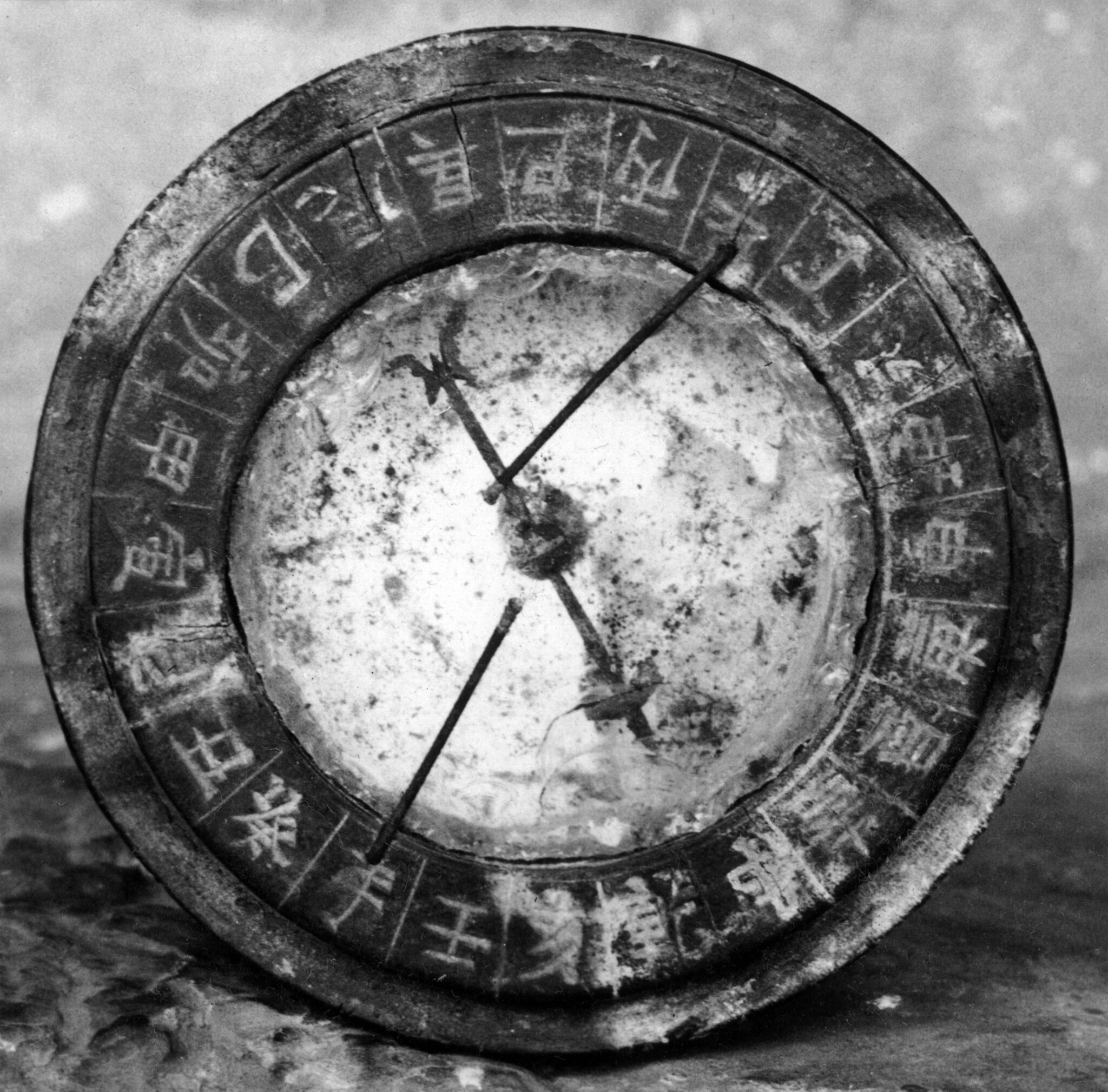
One classic example of the contrastingly different ways that Chinese people have thought about things is this week’s MEotW, “zhǐnán‐zhēn ((zhǐ·nán {(points with) finger → [points]} · south 指南)‐(zhēn needle 针 針) → [compass])”. While Westerners think of a compass as having a needle that points north, the literal meaning of the Mandarin word “zhǐnán‐zhēn ((zhǐ·nán {(points with) finger → [points]} · south 指南)‐(zhēn needle 针 針) → [compass])” is “points south needle”. Did the Chinese get it wrong? Are Westerners wrong? Neither! The fact is that as one end of a compass needle points north, the other end simultaneously points south. So, in this case, Westerners and Chinese people are both right—they’re just looking at the same thing from different points of view.

Sometimes, considering a different point of view, a different perspective, can help give one the mental—or even emotional—leverage needed to make a leap of progress that one would not otherwise make, if one was limited to one way of looking at things.

The fact that different languages come from different cultures, with their different perspectives and ways of thinking, is also why there is truth in the quote from Charlemagne that “to have another language is to possess a second soul.” (Of course, we know that by “soul” he meant what is described in the Insight on the Scriptures book entry for “Spirit”, under the subheading “Impelling Mental Inclination”.)

A Great Invention

Speaking of the compass, it’s also noteworthy that the compass is one of what are called the Four Great Inventions (Sì (Four 四) Dà (Big → [Great] 大) Fāmíng (Fā·míng {Sendings Out → [Bringings into Existence]} · {to Be Distinct} → [Inventions] 发明 發明)) from ancient China.

Chinese compass held at Queensland Museum c. 1938
Creative Commons Public Domain logo

As the Wikipedia article on the compass summarizes for us:

Among the Four Great Inventions, the magnetic compass was first invented as a device for divination as early as the Chinese Han Dynasty (since c. 206 BC),[source][source] and later adopted for navigation by the Song Dynasty Chinese during the 11th century.[source][source][source] The first usage of a compass recorded in Western Europe and the Islamic world occurred around 1190.[source][source]

So, maybe the Chinese actually got first dibs on getting to say which way a compass needle points, for whatever that’s worth, considering that a compass needle simultaneously points in two opposite directions. 😄

But Wait, There’s More!

In addition to the weirdness about a compass needle pointing both north and south simultaneously, I found the below weirdness summarized in the Wikipedia article on the North Magnetic Pole:

All magnets have two poles, where the lines of magnetic flux enter and emerge. By analogy with Earth’s magnetic field, these are called the magnet’s “north” and “south” poles. The convention in early compasses was to call the end of the needle pointing to Earth’s North Magnetic Pole the “north pole” (or “north-seeking pole”) and the other end the “south pole” (the names are often abbreviated to “N” and “S”). Because opposite poles attract, this definition means that Earth’s North Magnetic Pole is actually a magnetic south pole and Earth’s South Magnetic Pole is a magnetic north pole.[source][source]