📖 📄 ➕ Gēn (With 跟) Shàngdì (Shàng·dì Above’s · {Emperor → [God]} → [God] 上帝) de (’s 的) Zǐmín+ (Zǐ·mín Persons · People 子民) Yìqǐ (Yì·qǐ {Being One} · {Rising → [Group]} → [Together] 一起) Zhuīqiú (Zhuī·qiú Pursue · Seek 追求) Yǒngjiǔ (Yǒng·jiǔ Everlasting · {for a Long Time} 永久) de (’s 的) Píng’ān (Píng’·ān {Being Flat, Level, Even → [Being Peaceful]} · {Being Safe, Secure} (nwtsty-CHS Appx. A2 says this term mainly refers to things being smooth and stable, safe and secure, free of danger) 平安) Xìngfú (Xìng·fú {Good Fortune} · Blessings → [Happiness] 幸福) 🔼
📖 📄 ➕ [túpiàn (tú·piàn picture · {slice → [mw]} 图片 圖片) (jw.org)]
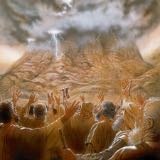
📖 📄 ➕ Gǔdài (Gǔ·dài (the) ancient · {replacings → [generations] → [period]} 古代) Yǐsèliè‐rén ((Yǐsèliè Israel 以色列)‐(rén people 人) → [Israelites]) céng (had 曾) méng+ ({been covered by} → [received] 蒙 蒙/懞) Shàngdì (Shàng·dì Above’s · {Emperor’s → [God’s]} → [God’s] 上帝) jiǎnxuǎn (choosing 拣选 揀選), zuòwéi (zuò·wéi {to become} · {to be} 作为 作為) Shàngdì (Shàng·dì Above’s · {Emperor’s → [God’s]} → [God’s] 上帝) zài (on 在) dìshang (dì·shang earth · upon 地上) de (’s 的) dàibiǎo+ (dài·biǎo {taking the place of} · {to show} (people) → [representatives] 代表)
📖 📄 ➕ 1, 2. (Jiǎ ({1st of the 10 Heavenly Stems} → [a] 甲)) Yēhéhuá (Jehovah 耶和华 耶和華) Shàngdì (Shàng·dì Above’s · {Emperor → [God]} → [God] 上帝) zěnyàng (zěn·yàng (in) what · {forms → [ways]} → [how] 怎样 怎樣) bǎ ({did hold} 把) Yǐsèliè‐rén ((Yǐsèliè Israel 以色列)‐(rén people 人) → [the Israelites]) zǔzhī+ (zǔ·zhī {(to be formed into) sections → [to be organized]} · {to be woven → [to be organized]} → [to be organized] 组织 組織) qilai (qi·lai up · {to come} 起来 起來), zuòwéi tā zài dìshang de dàibiǎo? (Yǐ) Shàngdì wèi‐shénme fàngqì Yǐsèliè‐guó? Shéi qǔdài tāmen?
📖 📄 ➕ CÓNG (FROM 从 從)‐GǓ ({ANCIENT (TIMES)} 古)‐DÀO ({ARRIVING AT} → [UP UNTIL] 到)‐JĪN ({THE PRESENT} 今), Zàowù‐Zhǔ+ ((Zào·wù Created · Things 造物)‐(Zhǔ Master 主) → [the Creator]) dōu yǒu tèdìng de ānpái, ràng suǒyǒu rèqiè xúnqiú tā de rén chóngbài tā. Huàn‐jù‐huà‐shuō, Yēhéhuá xiànglái dōu yǒu yí qún zhōngxīn shìfèng tā de rén, zài dìshang zǔzhī qilai, zuòwéi tā de dàibiǎo+ (dài·biǎo {taking the place of} · {to show} (persons) → [representatives] 代表).
📖 📄 ➕ 2 Gōngyuán Qián ((Gōng·yuán Common · Beginning → [C.E. (Common Era)] 公元) (Qián Before 前) → [B.C.E. (Before the Common Era)]) 16 shìjì (shì·jì generation · era → [century] 世纪 世紀), Yǐsèliè‐rén ((Yǐsèliè Israel 以色列)‐(rén people 人) → [the Israelites]) méng+ ({were covered by} → [received] 蒙 蒙/懞) Yēhéhuá (Jehovah’s 耶和华 耶和華) jiǎnxuǎn (choosing 拣选 揀選), cǐhòu (cǐ·hòu this · afterwards 此后 此後/后) 1500 nián (years 年 年/秊) jiān (within 间 間/閑) yìzhí (yì·zhí one · {being straight} → [all the while] 一直) shì ({(they) were} 是) Shàngdì (Shàng·dì Above’s · {Emperor’s → [God’s]} → [God’s] 上帝) zài (on 在) dìshang (dì·shang earth · upon 地上) de (’s 的) dàibiǎo (dài·biǎo {taking the place of} · {to show} (persons) → [representatives] 代表). (Chū‐Āijí‐Jì ((Chū {Going Out from} 出)‐(Āijí Egypt 埃及)‐(Jì Record 记 記) → [The Book of Exodus]) 19:5, 6) Yēhéhuá bǎ tāmen zǔzhī chéng yí ge guójiā, cìxia lǜfǎ, ānpái chóngbài de shì, hòulái gèng wěirèn jūnwáng tǒngzhì tāmen. Kěxī Yǐsèliè‐rén yízài duì Shàngdì bùzhōng. Gōngyuán 1 shìjì, Shàngdì zhōngyú fàngqìle Yǐsèliè‐rén. (Mǎtài Fúyīn 23:37, 38) Yēsū láidào dìshang shí, qīngchu biǎomíng rén guīxiàng Shàngdì de fāngfǎ. Tā shuō: “Wǒ jiùshì dàolù, zhēnlǐ, shēngmìng. Yào‐bu‐shì tōngguò wǒ, shéi yě bùnéng dào Fùqin nàli qù.” (Yuēhàn Fúyīn 14:6) Cóng nàshí qǐ, Shàngdì jiǎnxuǎn Yēsū Jīdū de méntú qǔdài Yǐsèliè‐guó, zài dìshang dàibiǎo tā. (Bǐdé Qiánshū 2:9, 10)
📖 📄 ➕ 3. Zǎoqī (Zǎo·qī early · period 早期) Jīdū‐tú+ ((Jīdū Christ 基督)‐(tú followers 徒) → [Christians]) shì (were 是) yì (one 一) qún+ ({group of} 群 群/羣) zěnyàng (zěn·yàng what · kind 怎样 怎樣) de (’s 的) rén (people 人)?
📖 📄 ➕ 3 Gōngyuán (Gōng·yuán Common · Beginning → [C.E. (Common Era)] 公元) 1 shìjì (shì·jì generation · era → [century] 世纪 世紀) de (’s 的) Jīdū‐tú ((Jīdū Christ 基督)‐(tú follower 徒) → [Christian]) huìzhòng+ (huì·zhòng congregated · multitude → [congregation] 会众 會眾) shì (were 是) ge ([mw] 个 個/个) tuánjié+ (tuán·jié {rolled into a ball → [united]} · {tied into a knot → [joined together]} → [united] 团结 團結) héyī (hé·yī {close → [joined]} · {(to be) one} 合一) de (’s 的) dìxiong (dì·xiong {younger brothers’} · {elder brothers’} → [brothers’] 弟兄) tuántǐ (tuán·tǐ {(thing) rolled into a ball → [group]} · body → [group] 团体 團體), zhìlì+ (zhì·lì {(who) sent → [(who) devoted]} · {(their) strengths → [(their) abilities]} 致力)‐yú (to 于 於/于) zhíxíng (zhí·xíng {catching → [grasping] → [carrying out]} · {walking → [doing]} 执行 執行) chuán ({to spread} 传 傳) fúyīn (fú·yīn (the) blessings · {sounds → [news]} 福音) de (’ 的) gōngzuò (gōng·zuò work · doing → [work] 工作). (Mǎtài Fúyīn ((Mǎtài Matthew’s 马太 馬太) (Fú·yīn Blessings · {Sounds → [News]} 福音) → [The Good News According to Matthew]) 28:19, 20) Tāmen jǐnshǒu Shèngjīng de zhēnlǐ, bìngqiě fènggōng‐shǒufǎ, zūnzhòng guānyuán, àihù línlǐ. Suīrán zhèyàng, tāmen què zāoyù měngliè de fǎnduì hé pòhài. Wèi‐shénme ne? Yīnwei tāmen jiānxìn, zhǐyǒu Shàngdì de Wángguó cái néng wèi rén dàilái yǒngjiǔ de píng’ān xìngfú, suǒyǐ tīngcóng Yēsū de fēnfu, quánlì zhīchí Shàngdì de Wángguó, duì shìshì yánshǒu zhōnglì, jùjué jūnshì fúwù, yě bù gānyù zhèngzhì. (Mǎtài Fúyīn 6:33; Yuēhàn Fúyīn 18:36) Tāmen suīrán chángqī bèi rén wùjiě, dàshòu fǎnduì hé pòhài, què réngrán rèxīn xuānyáng Shàngdì de Wángguó, jiāndìng‐bùyí. Bǎoluó zài Gēluóxī‐Shū shuō: “Zhèige hǎo xiāoxi chuángěi nǐmen, yòu zài quán shìjiè jiēchū guǒshí, búduàn zēngzhǎng”. 1 shìjì de Jīdū‐tú quèshí bǎ Shèngjīng de hǎo xiāoxi chuánbiànle Luómǎ Dìguó. (Gēluóxī‐Shū ((Gēluóxī Colossae 歌罗西 歌羅西)‐(Shū Writing → [Letter] 书 書) → [The Letter to the Colossians]) 1:6)
📖 📄 ➕ Hēi’àn (Hēi’·àn Black · Dark 黑暗 黑暗/闇) Shíqī (Shí·qī {(Particular) Time} · Period 时期 時期)—Jiǎ (False 假 假/叚)‐Jīdū‐Jiào ((Jīdū Christ 基督)‐(Jiào Teaching → [Religion] 教) → [Christianity]) Xīngqi+ (Xīng·qi Rises · {to Be Getting Up → [Up]} 兴起 興起) 🔼
📖 📄 ➕ 4, 5. Tiānzhǔ+ (Tiān·zhǔ Heavenly · Lord → [the Catholic] 天主) Jiàohuì (Jiào·huì Teaching · Association → [Church] 教会 教會) rúhé (rú·hé like · how → [how] 如何) chǎnshēng+ (chǎn·shēng {was given birth to → [was produced]} · {was given birth to → [was caused to exist]} → [was brought into being] 产生 產生)? Tiānzhǔ (Tiān·zhǔ Heavenly · Lord → [the Catholic] 天主) Jiàohuì (Jiào·huì Teaching · Association → [Church] 教会 教會) gēn (with 跟) zǎoqī (zǎo·qī (the) early · period 早期) Jīdū‐tú ((Jīdū Christ 基督)‐(tú follower 徒) → [Christian]) huìzhòng+ (huì·zhòng congregated · multitude → [congregation] 会众 會眾) yǒu ({did have} 有) shénme (shén·me what · [suf] 什么 什/甚麼) fēnbié (fēn·bié separatings · {otherings → [differentiatings]} → [differences] 分别 分別)?
📖 📄 ➕ 4 Kěxī (Kě·xī {(one) can} · regret → [unfortunately] 可惜), Jīdū‐tú ((Jīdū Christ 基督)‐(tú follower 徒) → [the Christian]) huìzhòng (huì·zhòng congregated · multitude → [congregation] 会众 會眾) hòulái (hòu·lái afterwards · {(it) came to be} 后来 後來) fāshēngle (fā·shēng·le {had issue forth} · {had come to life} · {to completion} → [had happen] 发生了 發生了) fān‐tiān‐fù‐dì+ ((fān {turning over} 翻)‐(tiān heaven 天)‐(fù overturning 覆)‐(dì {the earth} 地) → [earth-shaking (a rearrangement of fānfù tiāndì)]) de (’s 的) biànhuà (biàn·huà changings · transformings 变化 變化). Zhèngrú Shèngjīng yùgào, xǔduō jiǎ‐Jīdū‐tú ànzhōng hùnjìn Shàngdì de zǔzhī, bìng xíngchéng yì gǔ bùfǎ shìli, gǔchuī gēn Shèngjīng yǒu dǐchù de dàoli hé xísú. (Mǎtài Fúyīn ((Mǎtài Matthew’s 马太 馬太) (Fú·yīn Blessings · {Sounds → [News]} 福音) → [The Good News According to Matthew]) 13:24–30, 36–43; Shǐtú Xíngzhuàn ((Shǐ·tú Sent · Disciples’ → [Apostles’] 使徒) (Xíng·zhuàn Doings · Biography 行传 行傳) → [Acts]) 20:29, 30; Tiēsāluóníjiā Hòushū ((Tiēsāluóníjiā Thessalonica 帖撒罗尼迦 帖撒羅尼迦) (Hòu·shū Later · {Writing → [Letter]} 后书 後/后書) → [2 Thessalonians]) 2:6–8; Tímótài Qiánshū ((Tímótài Timothy 提摩太) (Qián·shū Earlier · {Writing → [Letter]} 前书 前書) → [1 Timothy]) 4:1–3; Tímótài Hòushū ((Tímótài Timothy 提摩太) (Hòu·shū Later · {Writing → [Letter]} 后书 後/后書) → [2 Timothy]) 2:16–18; Bǐdé Hòushū ((Bǐdé Peter’s 彼得) (Hòu·shū Later · {Writing → [Letter]} 后书 後/后書) → [2 Peter]) 2:1–3)
📖 📄 ➕ 5 Gōngyuán (Gōng·yuán Common · Beginning → [C.E. (Common Era)] 公元) 1 shìjì (shì·jì generation · era → [century] 世纪 世紀) de (’s 的) Jīdū‐tú ((Jīdū Christ 基督)‐(tú follower 徒) → [Christian]) huìzhòng (huì·zhòng congregated · multitude → [congregation] 会众 會眾) běn ({root or stem} → [originally] 本) méiyǒu (méi·yǒu not · {did have} → [did not have] 没有 沒有) jiējí+ (jiē·jí {step → [rank]} · {step → [class]} 阶级 階級) zhī (’ 之) fēn (dividings 分), kěshì dàole 2 shìjì, huìzhòng zhújiàn (zhú·jiàn {one (bit) by one (bit)} · gradually → [gradually] 逐渐 逐漸) xíngchéng (xíng·chéng form · {assumed the form of} → [formed] 形成) zhǔjiào+ (zhǔ·jiào master · {teaching (persons)} → [bishops] 主教) hé ({(together) with} → [and] 和 和/龢) zhǎnglǎo (zhǎng·lǎo {grown → [elder]} · old (men) → [presbyters] 长老 長老) jiēcéng+ (jiē·céng {steps → [ranks]} · strata → [social classes] 阶层 階層), ránhòu (rán·hòu {like that} · afterwards 然后 然後) yǒu ({(there) were having} → [(there) were] 有) jiàoshì+ (jiào·shì {teaching → [religion]} · {scholars → [persons trained in a certain field]} → [clergymen] 教士) hé ({(together) with} → [and] 和 和/龢) píng‐xìntú ((píng {flat, level, even} → [common] 平)‐(xìn·tú believing · followers 信徒) → [laity]) jiēcéng (jiē·céng {steps → [ranks]} · strata → [social classes] 阶层 階層). Jiēzhe (Jiē·zhe {coming into contact with → [taking hold of] (the baton next)} · being → [next] 接着 接着/著), Sān‐Wèi‐Yì‐Tǐ+ ((Sān Three 三)‐(Wèi Places → [mw for persons] 位)‐(Yì One 一)‐(Tǐ Body 体 體/体/躰) → [the Trinity]), línghún bùsǐ, dìyù yǒng huǒ, děng yìjiào zhǔzhāng xiāngjì róngrù Jīdū‐jiào xìnyǎng. Gōngyuán 313 nián, Luómǎ de Jūnshìtǎndīng Dàdì bānlìng, ràng biànzhì de Jīdū‐jiào chéngwéi héfǎ de zōngjiào. 4 shìjì‐mò, suǒwèi de Jīdū‐jiào gèng yáo‐shēn‐yí‐biàn, chéngwéi Luómǎ Dìguó de guānfāng zōngjiào, chēng Luómǎ Gōngjiào huò Tiānzhǔ‐jiào.
📖 📄 ➕ 6, 7. Jīdū Xīnjiào+ ((Jīdū Christ 基督) (Xīn·jiào New · {Teaching → [Religion]} 新教) → [Protestantism]) rúhé (rú·hé like · how → [how] 如何) chǎnshēng (chǎn·shēng {was given birth to → [was produced]} · {was given birth to → [was caused to exist]} → [was brought into being] 产生 產生)? Wèi‐shénme ((Wèi for 为 為)‐(shén·me what · [suf] 什么 什/甚麼) → [why]) shuō (say 说 說/説), Jīdū Xīnjiào ((Jīdū Christ 基督) (Xīn·jiào New · {Teaching’s → [Religion’s]} 新教) → [Protestantism’s]) gè (various 各) jiàohuì+ (jiào·huì teaching · associations → [churches] 教会 教會) yě (also 也) bú (not 不) shì (are 是) zhēnzhèng (zhēn·zhèng true · proper 真正) de (’s 的) Jīdū‐jiào ((Jīdū Christ 基督)‐(jiào teaching → [religion] 教) → [Christianity])?
📖 📄 ➕ 6 16 shìjì (shì·jì generation · era → [century] 世纪 世紀), Zōngjiào Gǎigé Yùndòng+ ((Zōng·jiào {School of Thought} · Teaching → [Religious] 宗教) (Gǎi·gé Changing · Reforming → [Reformation] 改革) (Yùn·dòng Carrying · Moving → [Movement] 运动 運動) → [the Reformation]) bàofā (bào·fā exploded · {issued forth} → [erupted] 爆发 爆發), wèi (for 为 為/爲) dāngshí (dāng·shí {at that} · {(particular) time’s} 当时 當時) Ōuzhōu+ (Ōu·zhōu {European (abbr. for Ōuluóbā)} · Continent → [Europe (abbr. for Ōuluóbā Zhōu)] 欧洲 歐洲) de (’s 的) zōngjiào (zōng·jiào {school of thought} · teaching → [religious] 宗教) shìjiè (shì·jiè {generation → [world]} · extent → [world] 世界) dǎkāi (dǎ·kāi {struck → [made]} · {to be opened up} 打开 打開) xīn (new 新) júmiàn+ (jú·miàn situations · {faces → [aspects]} 局面). Yìxiē zōngjiào gǎigé‐jiā, lìrú Lùdé, Cíwēnlì, Jiā’ěrwén děng, fēnbié zài bùtóng de wèntí shang dàlì pēngjī Tiānzhǔ Jiàohuì, jiéguǒ yí gègè zōngjiào tuántǐ zài gèdì chénglì, bǎituō Luómǎ Jiàotíng de xiázhì, tǒngchēng Kàng‐Luó‐Zōng (fǎnkàng Luómǎ de zōngpài) huò Jīdū Xīnjiào+ ((Jīdū Christ 基督) (Xīn·jiào New · {Teaching → [Religion]} 新教) → [Protestantism]).
📖 📄 ➕ 7 Zài (in 在) jiàohuì (jiào·huì teaching · associations → [churches] 教会 教會) de (’ 的) zǔzhī+ (zǔ·zhī {(being formed into) sections → [being organized]} · {being woven → [being organized]} → [organizational] 组织 組織) xíngshì (xíng·shì forms · styles 形式) fāngmiàn (fāng·miàn {direction → [side]} · face → [aspect] 方面), Jīdū Xīnjiào ((Jīdū Christ 基督) (Xīn·jiào New · {Teaching’s → [Religion’s]} 新教) → [Protestantism’s]) gè (various 各) jiàohuì (jiào·huì teaching · associations → [churches] 教会 教會) suī (although 虽 雖) gè (separately 各) yǒu (have 有) chāyì+ (chā·yì differences · {(ways) being different} 差异 差異), dàn jīběn‐shang réng fēnwéi jiàoshì jiējí hé píng‐xìntú jiējí (jiē·jí {step → [rank]} · {step → [class]} 阶级 階級); zài (in 在) jiàoyì+ (jiào·yì teachings · meanings → [doctrines] 教义 教義) fāngmiàn (fāng·miàn {direction → [side]} · face → [aspect] 方面), réng mòshǒu Sān‐Wèi‐Yì‐Tǐ ((Sān Three 三)‐(Wèi Places → [mw for persons] 位)‐(Yì One 一)‐(Tǐ Body 体 體/体/躰) → [the Trinity]), línghún bùsǐ, sǐ hòu yǒngyuǎn shòukǔ děng dǐchù Shèngjīng de zhǔzhāng; zài zhèngzhì zhōnglì fāngmiàn, Jīdū Xīnjiào gè jiàohuì yě xiàng Luómǎ Tiānzhǔ Jiàohuì yíyàng, jìxù shǔyú shìjiè. Zōngjiào Gǎigé Yùndòng ((Zōng·jiào {School of Thought} · Teaching → [Religious] 宗教) (Gǎi·gé Changing · Reforming → [Reformation] 改革) (Yùn·dòng Carrying · Moving → [Movement] 运动 運動) → [the Reformation]) suī dàilái ruògān gǎibiàn, Jīdū Xīnjiào què shǐzhōng méiyǒu fùxīng zhēnzhèng de Jīdū‐jiào. Búguò, Yēsū zài bǐyù zhōng yùgào, shíhou dàole, zhēn Jīdū‐jiào bìrán fùxīng, yǒurú xiǎomài de zhēn Jīdū‐tú huì xiàng tàiyáng yíyàng “míngliàng de zhàoyào”. (Mǎtài Fúyīn ((Mǎtài Matthew’s 马太 馬太) (Fú·yīn Blessings · {Sounds → [News]} 福音) → [The Good News According to Matthew]) 13:24–30, 36–43)
📖 📄 ➕ Shàngdì (Shàng·dì Above’s · {Emperor → [God]} → [God] 上帝) de (’s 的) Xiàndài+ (Xiàn·dài {Appearing → [Current]} · {Replacing → [Generation] → [Era]} → [Modern] 现代 現代) Zǔzhī (Zǔ·zhī {(Formed into) Sections → [Organized]} · {Woven → [Organized]} (System) → [Organization] 组织 組織) 🔼
…